
[Paper Review] DIFIX3D+: Improving 3D Reconstructions with Single-Step Diffusion Models
Introduction
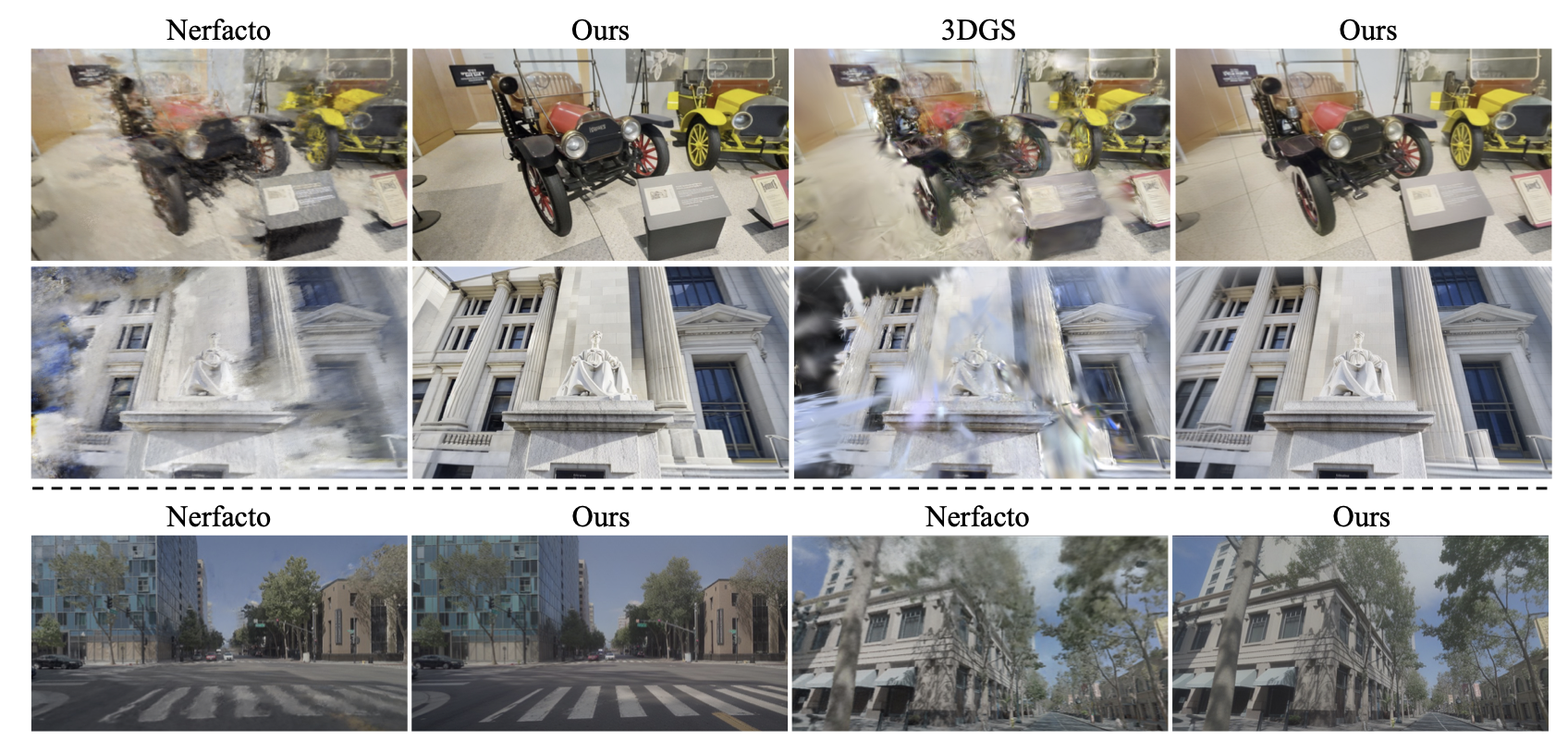
In this post, I review “DIFIX3D+: Improving 3D Reconstructions with Single-Step Diffusion Models” at CVPR 2024 by Jay Zhangjie Wu et al. The paper proposes a single-step diffusion-based fixer DIFIX that (1) improves the 3D representation during training and (2) acts as a real-time post-render enhancer at inference. A single model works for both NeRF and 3D Gaussian Splatting (3DGS) backbones, targeting artifacts that appear in sparse coverage and extreme novel viewpoints.
Paper Info
- Title: DIFIX3D+: Improving 3D Reconstructions with Single-Step Diffusion Models
- Authors: Jay Zhangjie Wu, Yuxuan Zhang, Haithem Turki, Xuanchi Ren, Jun Gao, Mike Zheng Shou, Sanja Fidler, Zan Gojcic, Huan Ling
- Conference: CVPR 2025
- Project: NVIDIA Toronto AI (DIFIX3D)
Motivation
Even with strong reconstructors like NeRF and 3DGS, underconstrained regions — sparse views, pose noise, lighting inconsistencies — cause ghosting, spurious geometry, and missing regions, especially far from training poses. Per-scene optimization is also vulnerable to shape–radiance ambiguity. Large 2D diffusion models learn broad image priors, but repeatedly querying them during 3D optimization is slow and often object-centric. The question DIFIX3D+ poses is whether a fast, single-step image diffusion model can fix neural render artifacts and then distill those fixes back into 3D for multi-view consistency.
Core Idea
DIFIX3D+ uses a single-step diffusion model (SD-Turbo base) fine-tuned as an artifact fixer (DIFIX) with reference-mixing attention:
- Reconstruction-time distillation (DIFIX3D)
- Interpolate poses from reference → target, render pseudo novel views from the current 3D model.
- Apply DIFIX to clean artifacts.
- Distill cleaned images back into the 3D model.
- Progressively expand trajectory coverage with small pose perturbations (~every 1.5k steps), iterating until the target poses are well-conditioned.
- Inference-time enhancement (DIFIX3D+)
- After training, run DIFIX once per rendered frame as a real-time post-processor (~76 ms on A100).
This two-stage design yields consistent improvements in both pixel metrics and perceptual quality while remaining fast.
Background
NeRF volume rendering for a ray \(r(t)=\mathbf{o}+t\mathbf{d}\):
\(C = \sum_{i=1}^{N} \alpha_i\, \mathbf{c}_i \prod_{j<i}(1-\alpha_j),
\quad \alpha_i = 1 - \exp(-\sigma_i \,\delta_i).\)
3DGS replaces sampled points with Gaussians (mean \(\boldsymbol\mu_i\), covariance \(\boldsymbol\Sigma_i\), opacity \(\eta_i\)):
\(\alpha_i = \eta_i \exp\!\Big(-\tfrac{1}{2}(\mathbf{p}-\boldsymbol\mu_i)^\top \boldsymbol\Sigma_i^{-1}(\mathbf{p}-\boldsymbol\mu_i)\Big),\)
with \(\boldsymbol\Sigma = \mathbf{R}\mathbf{S}\mathbf{S}^\top \mathbf{R}^\top\).
Both yield artifacts when supervision is weak—precisely what DIFIX targets.
DIFIX: A Single-Step Diffusion Fixer
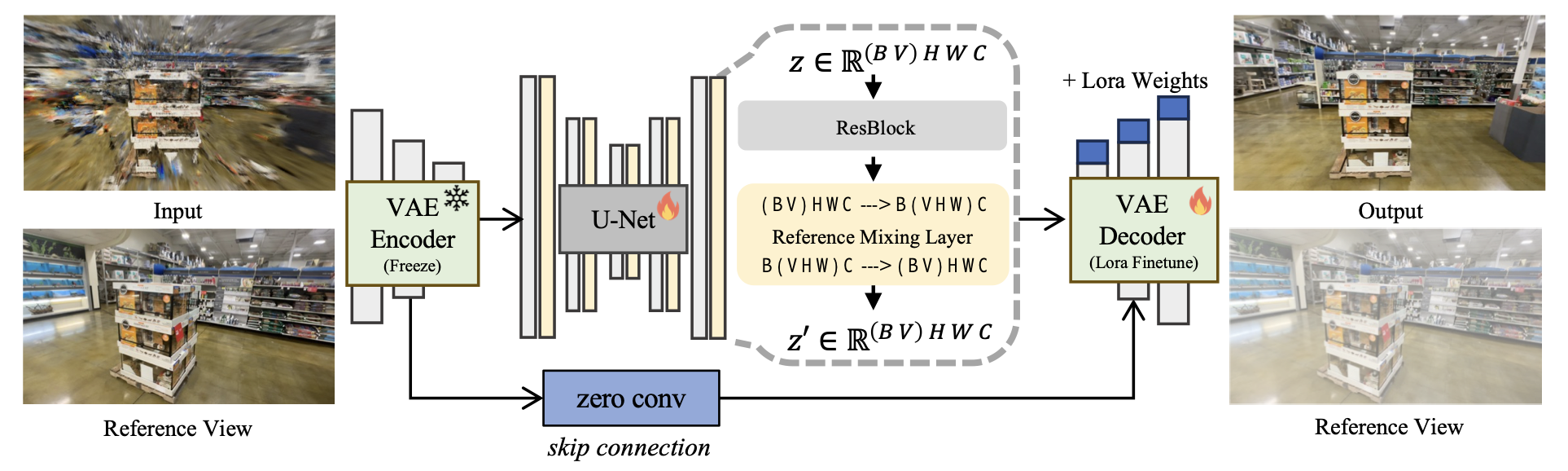
Backbone & conditioning. DIFIX starts from SD-Turbo and is turned into an image-to-image artifact remover with reference-mixing attention. Given a degraded render \(\tilde{I}\) and one (or few) reference views \(I_{\text{ref}}\), frames are encoded to latents \(z \in \mathbb{R}^{V\times C\times H\times W}\). A reference-mixing layer reshapes across the \((V,H,W)\) axes to perform attention over all views/spatial tokens, letting the model pull structure/texture cues from references while preserving the target view’s layout.
Noise level selection. Instead of the usual \(\tau{=}1000\), DIFIX uses \(\tau \approx 200\), matching the “artifact distribution” of neural renders to a single-step denoising that removes artifacts without hallucinating away scene content.
Losses. Trained with 2D supervision only: \(L = \underbrace{\| \hat{I}-I \|_2^2}_{L_{\text{Recon}}} + \underbrace{\text{LPIPS}(\hat{I}, I)}_{L_{\text{Percep}}} + \underbrace{0.5\,\sum_{\ell}\|\mathbf{G}_\ell(\hat{I})-\mathbf{G}_\ell(I)\|_2^2}_{L_{\text{Gram}}}\),
where \(\mathbf{G}_\ell(I)=\phi_\ell(I)^\top \phi_\ell(I)\) is the Gram matrix of VGG-16 features.
Data curation to simulate realistic artifacts and get paired (corrupted, clean) supervision:
- Sparse reconstruction (hold-out views),
- Cycle reconstruction (shift trajectory by ~1–6 m on driving data, render & swap),
- Cross-reference (multi-cam rigs; train on one cam, render others),
- Model underfitting (short schedules to amplify artifacts).
Progressive 3D Updates (DIFIX3D)
To avoid per-frame inconsistencies from pure post-processing, DIFIX outputs are distilled back into the 3D model with progressively expanding pose perturbations. Sketch:
- Train on reference views.
- Every ~1.5k iters: slightly perturb poses toward targets → render → DIFIX → add to training set.
- Repeat until coverage reaches target views.
This curriculum strengthens multi-view conditioning, taming flicker and stabilizing high-freq details.
Real-Time Post-Render (DIFIX3D+)
Even after distillation, tiny residual artifacts remain (capacity limits, supervision gaps). A final single-step pass of DIFIX at test time cleans them up in ~76 ms/frame (A100)—> practical for real-time or interactive viewers.
Results
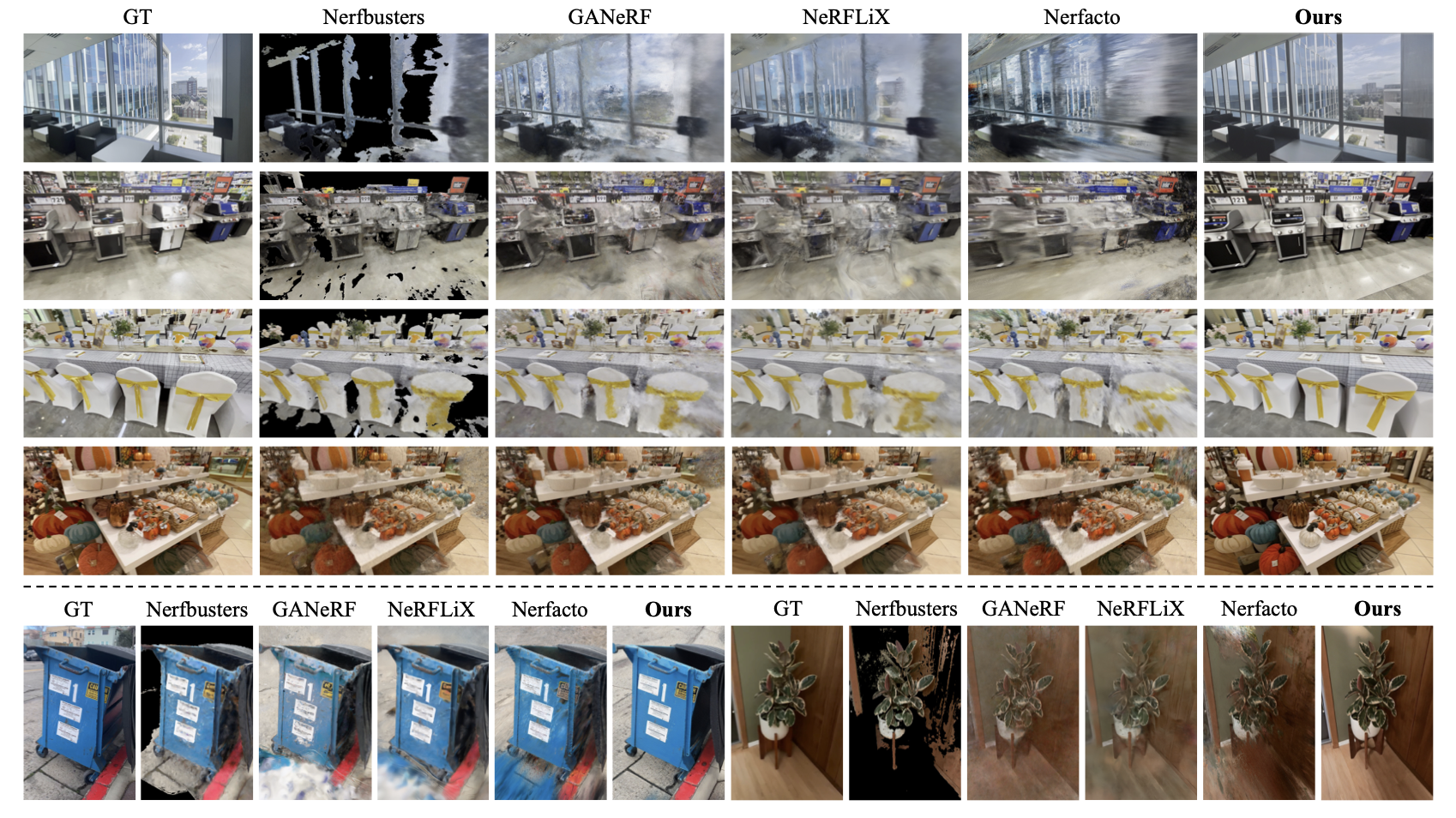
- Backbones: Nerfacto (NeRF) and 3DGS both benefit.
- Benchmarks: DL3DV (in-the-wild), Nerfbusters (artifact stress-test), and an internal RDS automotive dataset.
- Gains (typical ranges reported):
- PSNR: about +1 dB,
- FID: roughly 2–3× lower,
- LPIPS: consistently lower,
- improved TSED (epipolar consistency) vs. baselines.
- Speed: single-step inference makes integration more than 10× faster than methods that query diffusion at every training step.
One model handles both NeRF and 3DGS artifact patterns.
Comparisons & Positioning
- Vs. NeRFLiX / reference aggregation: Deterministic enhancers help near references but blur/hallucinate under ambiguity. DIFIX adds generative priors while the distillation loop keeps multi-view consistency.
- Vs. diffusion-at-every-step: DIFIX3D+ avoids prohibitive slowdowns by batching diffusion calls into pseudo-view creation rounds + single-step inference.
- Vs. 3DGS-Enhancer / Deceptive-NeRF: Similar spirit (augment pseudo-views), but progressive pose curriculum and real-time post-render are key differentiators.
Limitations
- Dependent on the 3D base: If the reconstruction fails catastrophically (e.g., missing whole objects), DIFIX cannot conjure geometry.
- Prior bias: As a 2D prior, DIFIX may prefer plausible but dataset-typical textures/colors if supervision is extremely weak.
- Residual temporal jitter: Pure post-processing can flicker; the progressive distillation mitigates this, but extreme sparsity still challenges perfect coherence.
Practical Notes
- Plug-and-play: Works with Nerfstudio-style pipelines (Nerfacto) and modern gsplat renderers for 3DGS.
- Training: LoRA-style finetune (freeze VAE encoder; finetune decoder); reference-mixing attention layers are simple to drop in.
- Noise level: \(\tau \approx 200\) is the sweet spot—too high (\(600\text{–}1000\)) over-hallucinates; too low (\(\leq 10\)) under-fixes.
Conclusion
DIFIX3D+ shows that single-step diffusion can serve as a general tool for fixing neural render artifacts: distill cleaned pseudo-views to improve the 3D representation itself, then finish with a real-time enhancer at test time. The result is sharper, more consistent novel views across both NeRF and 3DGS, with clear perceptual gains at modest cost.