[Paper Review] SANA: EFFICIENT HIGH-RESOLUTION IMAGE SYNTHESIS WITH LINEAR DIFFUSION TRANSFORMERS
Introduction
In this post, I review SANA: Efficient High-Resolution Image Synthesis with Linear Diffusion Transformers by Enze Xie et al. (NVIDIA, MIT, Tsinghua), published at ICLR 2025.
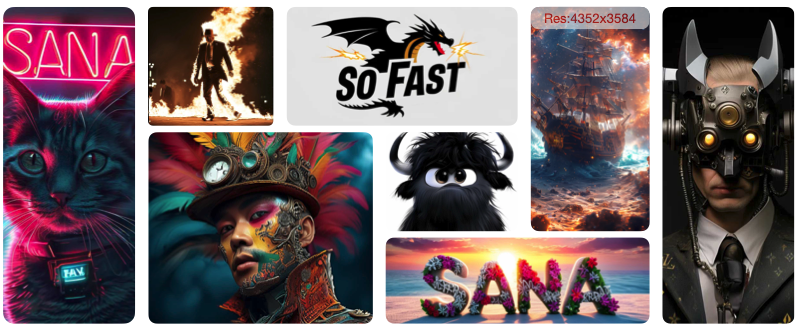
SANA is a linear-time diffusion transformer that generates 4K images within seconds on consumer GPUs. Instead of scaling model size like FLUX or SD3, it gets its efficiency from three ideas — deep compression, linear attention, and LLM-based text conditioning — and rivals FLUX in quality with roughly 20× fewer parameters and 100× faster inference.
Paper Info
- Title: SANA: Efficient High-Resolution Image Synthesis with Linear Diffusion Transformers
- Authors: Enze Xie, Junsong Chen, Junyu Chen, Han Cai, Haotian Tang, Yujun Lin, Zhekai Zhang, Muyang Li, Ligeng Zhu, Yao Lu, Song Han
- Affiliations: NVIDIA, MIT, Tsinghua University
- Conference: ICLR 2025
- Code: SANA (GitHub)
Background: From U-Nets to Linear Diffusion Transformers
Most text-to-image diffusion models such as Stable Diffusion 3, PixArt-Σ, or FLUX rely on U-Net denoisers with quadratic attention cost.
This limits scalability beyond 1K resolution and demands multi-billion parameter models.
SANA departs from this trend by replacing the U-Net with a Transformer-only denoiser optimized for O(N) complexity.
A deep-compression autoencoder (AE-F32C32) reduces latent token count by 16×, allowing real-time high-resolution diffusion.
Problem Definition
Given a text prompt \(p\) and latent noise \(\mathbf{z}_T\),
a diffusion model reconstructs an image \(\mathbf{x}_0\) through:
SANA learns a velocity-based denoising function \(v_\theta(\mathbf{z}_t, t, p)\) under the Rectified-Flow formulation:
\[\frac{d\mathbf{z}_t}{dt} = v_\theta(\mathbf{z}_t, t, p),\]allowing direct trajectory prediction between noise and clean latents for faster convergence.
Architecture Overview
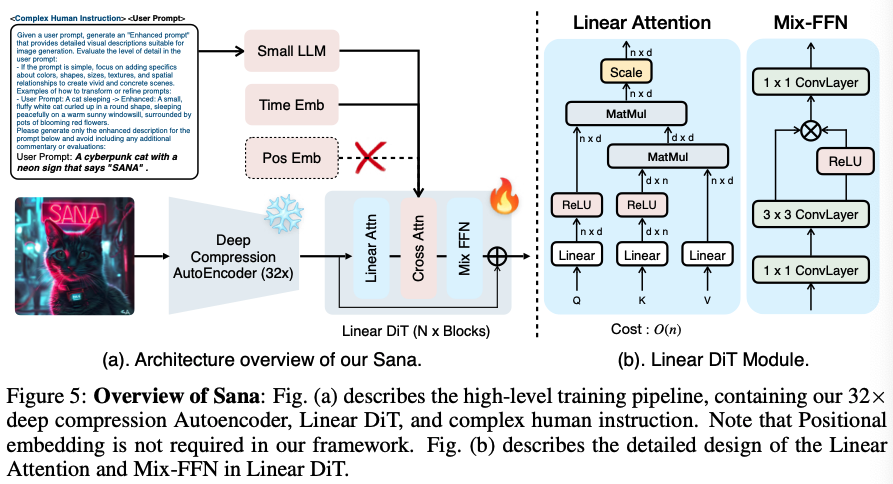
SANA integrates three co-optimized components — a deep compression autoencoder, a Linear Diffusion Transformer (Linear-DiT), and a decoder-only LLM-based text encoder — into a single Rectified-Flow diffusion pipeline.
Unlike conventional LDMs that loosely connect compression, denoising, and conditioning, SANA treats them as mutually constrained modules that together reduce token count, memory access, and diffusion step count.
The full pipeline compresses, conditions, and denoises in a 32× latent space with \(O(N)\) attention, reaching 4K synthesis in single-digit seconds.
1. Deep Compression Autoencoder (AE-F32C32)
SANA’s autoencoder maps an image
\(\mathbf{x} \in \mathbb{R}^{3 \times H \times W}\)
into a latent grid
Key properties:
- Downsampling factor (F=32) → each dimension reduced 32× (vs 8× in SDXL), giving 1/16 the token count.
- Channel depth (C=32) balances reconstruction quality and token sparsity, achieving rFID = 0.34, PSNR = 29.3 dB at 4K.
- No patch flattening (
P=1): AE performs all spatial compression, keeping diffusion tokens semantically dense. - Multi-stage fine-tuning (512 → 1K → 2K → 4K) with LPIPS + SSIM losses preserves texture fidelity.
- Efficiency gain: at 4K (4096²), only 128×128 = 16 K latent tokens feed the transformer—small enough for linear attention to scale linearly in both FLOPs and memory.
2. Linear Diffusion Transformer (Linear-DiT)
The denoising backbone is a Transformer-only architecture with ReLU linear attention:
\[\text{Attn}(Q,K,V) = \frac{\mathrm{ReLU}(Q)\,[\,(\mathrm{ReLU}(K)^\top V)\,]} {\mathrm{ReLU}(Q)\,[\,(\mathrm{ReLU}(K)^\top \mathbf{1})\,]},\]achieving O(N) complexity in both time and memory.
Each block follows the structure:
LayerNorm → Linear Attention → Mix-FFN → Residual
Mix-FFN merges a 1×1 MLP, a 3×3 depthwise convolution, and a Gated Linear Unit (GLU).
This reintroduces local spatial bias lost in linear attention, removing the need for positional encodings (NoPE design).
Empirically, this yields improved long-range coherence and stability across large image scales.
Additional design notes:
- Kernel fusion (Triton) combines projection, activation, and normalization (≈ +10% runtime gain).
- Depth/width: 28 blocks @ 1152d (SANA-0.6B) or 20 blocks @ 2240d (SANA-1.6B).
- Complexity: Linear in resolution, bounded by memory bandwidth rather than attention scaling.
3. LLM-Based Text Conditioning (Gemma-2 + CHI)
SANA replaces encoder–decoder T5 with Gemma-2, a compact decoder-only LLM trained with instruction following.
Prompts are expanded via Complex Human Instruction (CHI) templates that rewrite under-specified inputs (e.g., “a cat” → “a fluffy white cat curled up by a sunlit window”).
This enhances the contextual grounding of the diffusion model.
Implementation details:
- Extract final-layer decoder states as semantic embeddings.
- Apply RMSNorm + scale 0.01 to stabilize gradients (without it, NaNs occur).
- Keys/values in cross-attention come from Gemma embeddings; queries from latent tokens.
- Improves text-image alignment by ≈ +2 CLIP score and reduces prompt drift at 4K.
4. Flow-Based Denoising with Flow-DPM-Solver
SANA trains under the Rectified-Flow objective:
\[\mathcal{L}_{\text{flow}} = \big\|\,v_\theta(\mathbf{z}_t,t,p) - (\boldsymbol{\epsilon}-\mathbf{x}_0)\,\big\|_2^2,\]predicting velocity instead of noise.
A modified Flow-DPM-Solver adapts DPM-Solver++ with rectified-flow scaling (α → 1−σ), achieving convergence in 14–20 steps—about 2–3× fewer than Euler-based solvers.
Combined with cascade-resolution training, this enables fast 1K–4K synthesis with minimal perceptual degradation.
5. System-Level Efficiency
- INT8 (W8A8) quantization with per-channel scaling for weights & activations → 2.4× speed-up at negligible quality loss.
- CUDA/Triton kernel fusion merges QKV projection, GLU, and quantization stages.
- Latency: 0.37 s @ 1K on RTX 4090 laptop, 5.9 s @ 4K on A100.
- Throughput: ~40× faster than SDXL, ~100× faster than FLUX-Dev.
Results Summary
| Model | Params | Resolution | FID↓ | CLIP↑ | GenEval↑ | 4K Speed (A100) |
|---|---|---|---|---|---|---|
| FLUX-dev | 12 B | 4K | 5.7 | 28.7 | 0.66 | 1023 s |
| SANA-1.6B | 1.6 B | 4K | 5.8 | 28.6 | 0.66 | 5.9 s |
| SANA-0.6B | 0.6 B | 1–4K | 5.81 | 28.36 | 0.64 | 9.6 s |
SANA matches the quality of 12B-parameter models
while being over 100× faster at 4K resolution.
Limitations
- Training still requires large-scale compute despite architectural efficiency.
- Mild blur at ultra-high (>8K) resolutions from linear attention approximation.
- Compression limits extreme zoom or detailed inpainting.
- Lacks fine-grained region-based or controllable editing interface.
Takeaways
SANA’s main point is that efficiency can come from architecture rather than raw scale. Deep compression, linear attention, and an LLM text encoder together bring real-time, high-fidelity text-to-image generation at 4K within reach on consumer hardware.
A couple of threads connect back to 3D vision and Gaussian rendering:
- Flow-based denoising parallels single-step 3D refinement (e.g. DIFIX3D+).
- Linear attention may help with scalable 2D–3D latent fusion in future rendering pipelines.